
Rethink Plastic Newsletter – Spring 2026 Edition
Welcome (back) to the Rethink Plastic alliance newsletter!
Welcome to the first edition of the Rethink Plastic Alliance Newsletter! If you haven’t signed up yet, you can subscribe to our newsletter here to receive our quarterly updates on all plastics-related EU policy developments.
Why did we bring back the RPA newsletter? Access to well-researched and digestible information on policy and the environment is more important than ever. We want to make sure that our reports, blog posts, and policy briefings reach all those who are interested, irrespective of changing algorithms and the political affiliations of platform owners.
What can you expect from the newsletter? The newsletter will be released on a quarterly basis and will bring you up to date with all the latest developments on plastics in EU policy. It will feature all the latest news and publications from Rethink Plastic and our member organisations.
So let’s dive right in!

Is the Packaging Regulation ready to be implemented?
The EU’s Packaging and Packaging Waste Regulation (PPWR) already entered into force at the beginning of last year and will be a cornerstone of the EU’s aims to minimise the quantities of packaging produced and waste generated. The Regulation will apply from August 2026, but uncertainty around the interpretation of certain provisions of the PPWR was threatening to delay its implementation. In response to this, we welcome the European Commission’s publication of guidance to provide the necessary clarity for consistent interpretation of the Regulation across Member States. Implementation must now proceed without delay, as that would risk undermining the Regulation’s objectives.
Rethink Plastic published our initial reaction to the guidance with our take on the interpretation:
✅ We commend the Commission for upholding the restrictions on PFAS in food contact packaging;
❌ We strongly disagree with the interpretation that plasticised paper-based packaging containing less than 5% plastic would fall outside the ban on single-use plastic packaging for indoor dining;
✅ We welcome the Commission’s reaffirmation of the obligation to establish deposit return schemes for single-use plastic bottles and metal beverage containers by 2029;
❌ We are concerned that the Single Market harmonisation rationale may be misused to excessively restrict the ability of national and local authorities to go beyond EU minimum requirements on waste reduction and reuse.
Evaluating the Single-Use-Plastic Directive – a flagship law that delivered clear, positive outcomes
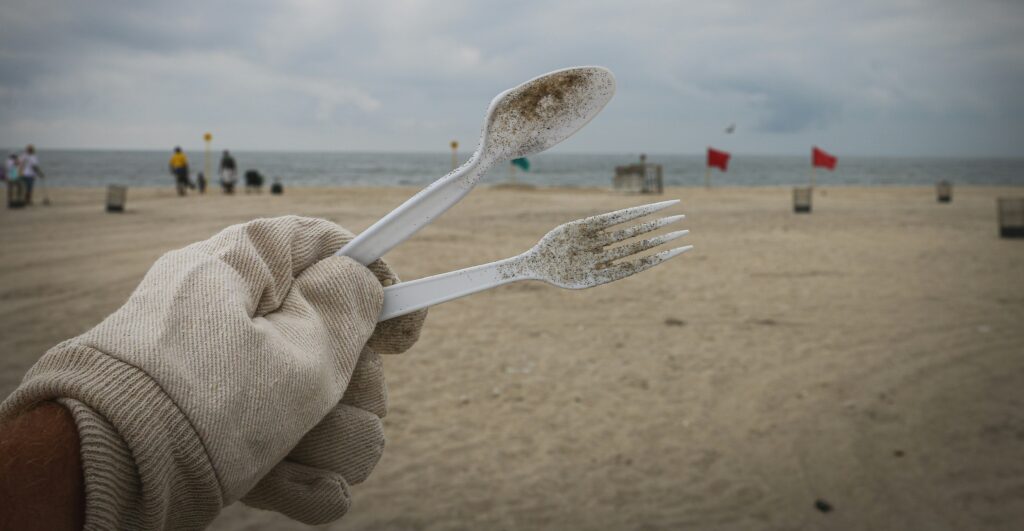
Can you believe that it’s been seven years since the Single-Use-Plastics Directive (SUPD) entered into force? The SUPD addresses ten common highly polluting single-use plastic items to prevent and reduce the impact of these plastic products on the environment and human health. To evaluate the impact of this law, the Commission launched a public consultation at the end of 2025, which the Rethink Plastic Alliance responded to. The SUPD is where it all started for the Alliance and throughout the years, we have conducted several of our own evaluations across Europe. They all showed that, while implementation was not perfect, the SUPD had clear and significantly positive outcomes – notably through effective product bans and design requirements such as tethered caps, which have proven implementable, visible, and impactful in reducing litter and preventing pollution at source.
In our feedback to the evaluation, we stress that a broad revision of the directive would be premature at this stage. However, if the Commission does decide to revise the Directive, we recommend certain targeted improvements to ensure that any changes reinforce, rather than weaken, its environmental objectives and pollution-prevention measures.
European Commission embraces problematic chemical “recycling” technologies
In December 2025 (on the 23rd, to be precise) the Commission published, a package of short-term initiatives with the aim of “boosting the circularity of plastics” leading up towards the Circular Economy Act foreseen for late 2026. An early Christmas present? Unfortunately, the package was quite a mixed bag. Next to some positive elements (more about those later), the package saw the Commission fully endorsing chemical “recycling” for the first time. Concretely, the Commission’s Implementing Act of the Single Use Plastic Directive now allows for chemical “recycling” technologies to be used to account towards the Commission’s recycled content targets for single-use plastic beverage bottles.
So what is the problem with chemical “recycling” (and why do we keep using “recycling” in quotation marks)? Chemical recycling is an umbrella term for several processes that change the chemical structure of plastic waste (check out our blog post and reports for in-depth information). Chemical “recycling” has been suggested as the magical solution to the recycling crisis by vested interests (read: petrochemical giants), but many of the actual technologies are wholly unsuited to actually recycle plastic. Take pyrolysis, for example, a process that changes chemical composition through exposure to extreme heat. Not only does it emit a staggering amount of greenhouse gases, but its yields are also very low. Most yields are so contaminated that they cannot even be used to create new plastics, but are instead used as fuel. That is why we insist that pyrolysis should be considered a recovery process rather than a genuine recycling technology (hence the quotation marks around “recycling”). By endorsing such problematic technologies, as well as embracing the questionable mass balance accounting and dual-use output approach, the Commission sets dangerous precedent for future legislation, enabling greenwashing around recycling.
End-Of-Waste criteria: When does waste stop being waste and when can it be considered a product again?
To support its transition to a circular economy, the EU wants to boost the use of waste-derived materials, also commonly referred to as “secondary raw materials”. In practice, this means that new products should preferably be made using recycled materials to reduce extraction of primary materials. This goal makes a lot of sense, especially when considering that out of the approximately 58 million tonnes of plastic currently produced in the EU, only half is collected and sorted, and only around 13% is recycled into new plastics.
But the transition from waste to a resource fit to be used in new products is not as simple as it sounds. This is why the Commission looked into the legal implications of this process as part of its December package. It proposed so-called “End-of-Waste (EoW) criteria” to legally define the moment when a material ceases to be waste and becomes a waste-derived material that can be used as a product. This legal change matters: once a material is no longer classified as waste, but as a waste-derived material meeting EoW criteria, another regulatory framework – the chemical and product framework – applies. The legislative regime governing products is usually less restrictive than the one regulating waste. The Commission’s proposal has many promising elements, but as it stands, the proposal has gaps, especially on chemicals, which will undermine the long-term circular economy in Europe and beyond. If you want more information on all things End-of-Waste, you can check out our FAQ blog on the topic, as well as our RPA briefing.
Towards an Ocean free from plastic pollution – Rethink Plastic’s recommendations for the Ocean Act
Over a decade ago the shocking images of marine pollution and its impact on marine wildlife caused outrage among people and kickstarted awareness of the plastic pollution crisis. While the harmful impacts of plastic pollution are not limited to the ocean, ocean pollution still remains a deeply concerning issue. As part of its Ocean Pact, the EU is currently working on an Ocean Act, a critical opportunity to align climate, biodiversity and maritime policies under a coherent framework. We submitted our Rethink Plastic recommendations to the public consultation, calling on the Commission to enshrine existing 2030 targets on reducing plastic litter and microplastic emissions, as well as to add new 2040 targets, in the Ocean Act. We advocate for the Act to set an holistic and systemic approach to ocean governance and protection, with prevention and precautionary principles at its core.
Quo vadis, Plastics Treaty?
While we still don’t know when and where the next session of the negotiation round for a Global Plastics Treaty will be held, the election of Julio Cordano as new Chair might help drive the stalled process forward. However, his election will not fix the process in itself, reflects David Azoulay (Center for International Environmental Law), who stresses the need for the process to make more frequent use of voting, rather than being blocked by consensus:
“While electing a chair keeps the process alive, it won’t fix what’s broken in and of itself. (The February) session was once again dominated by the same delay tactics and obstruction that have bogged down the negotiations from the beginning. The negotiations are in desperate need of a reset. For years, a small handful of States have told us that consensus is the only way to make decisions — today proved that when it matters, governments can and will use all the tools of multilateralism available to them, including voting. No more delays and no more excuses — Members of the Committee must show willingness to deliver an ambitious, legally-binding treaty that tackles plastic pollution starting at the source.”
Unpacking the EU’s packaging regulations – best practices for packaging standards
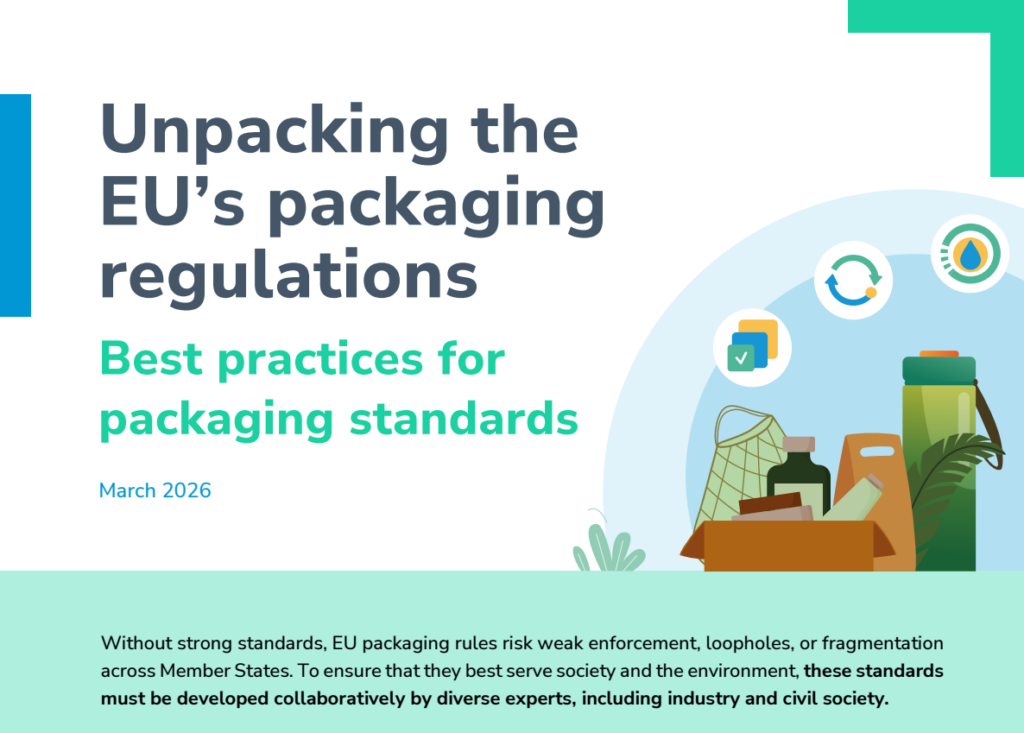
Implementing the EU’s Packaging and Packaging Waste Regulation (PPWR), now depends on technical rules and harmonised European standards. In their latest factsheet, ECOS provides an overview of the PPWR’s upcoming milestones and targets on packaging minimisation, reuse, and refill – as well as key insights from experts on these three pillars of standardisation under the EU’s new packaging rules.

Harnessing the power of citizen science for the ocean – discover Retrace! by Surfrider
For nearly 30 years, Initiatives Océanes has been a landmark Surfrider project aimed at engaging citizens in the fight against water pollution. Now, Initiatives Océanes is evolving into Retrace!, a project keeping the same values and the same goal: to track waste back to its source.
Retrace! invites anyone who wants to take concrete action to organize or join beach and riverside cleanup efforts. This initiative goes far beyond a simple cleanup: it turns every participant into a contributor to a large-scale collective survey!
Towards a future free from plastic pollution!
Thanks for reading, we will be back in a couple of months with some more updates! In the meantime, follow us on LinkedIn and BlueSky and keep an eye on our website to follow developments on EU plastics policy.
Caroline, on behalf of the Rethink Plastic Alliance