Implementing the PPWR requirements on minimum recycled content in plastic packaging now depends on the development of robust and reliable secondary legislation on (1) the calculation and verification of recycled plastic content in packaging, (2) sustainability criteria for plastic recycling technologies, and (3) equivalent rules for plastic recycled content that is
imported from third countries.
End of Waste Criteria to achieve a Toxic-Free Circular Economy in the EU
The development of End-of-Waste criteria can support the EU’s transition to a circular economy. EU EoW policy must be driven by transparency and traceability, clarity and enforceability, and non-toxicity. This will enable genuine circularity, ensure high protection of human health and the environment, and support the EU’s leadership in high-quality waste-derived materials.
Rethink Plastic Alliance provides feedback on End-of-Waste Criteria for Plastic Waste
The Rethink Plastic Alliance welcomes the opportunity to provide feedback on the Commission’s draft Implementing Regulation to set harmonised End-of-Waste (EoW) criteria for plastics in the EU. Overall, we welcome the proposed EoW criteria for plastics but we urge the EU to strengthen the criteria for eligible inputs and control mechanisms to ensure genuine circularity. Our position is outlined in more detail in the attached document.
Rethink Plastic provides feedback on new rules for chemically-recycled content in plastic bottles
Input to the public consultation on the draft Implementing Decision laying down rules for recycled content in single-use plastic beverage bottles, including chemically-recycled content. The proposed Implementing Decision does not comply with the principle of proportionality and exceeds the scope of the implementing power granted by the Single Use Plastics Directive.
Scrutinising Scientific Standards
A Scientific Assessment of the JRC Study on European Sustainability Criteria for Plastics Recycling Technologies
The aim of this report is to allow for a better understanding of the full environmental impacts of different plastic recycling technologies.
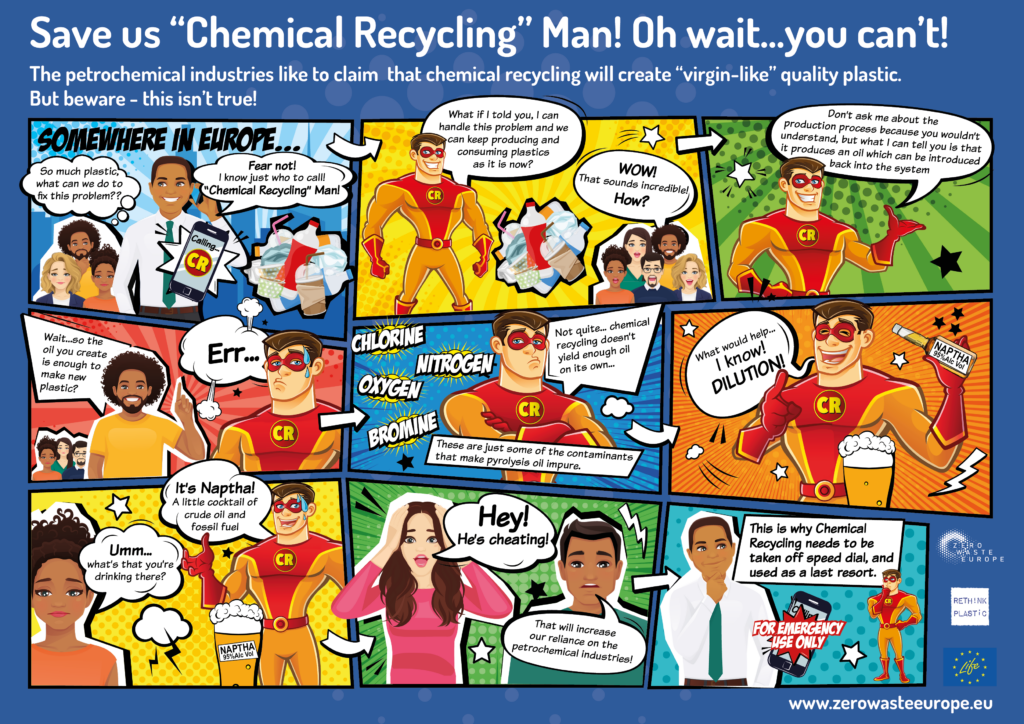
Save us “Chemical Recycling” Man! Oh wait…you can’t!
Meet “Chemical Recycling” Man. Not your run-of-the-mill comic book superhero. This one is propped up by the petrochemical industries.
These industries like to claim that chemical recycling will create “virgin-like” quality plastic. But beware – this isn’t true! Because of low oil yields and contamination, pyrolysis oil must be diluted by a mixture made up of crude oil, derived from fossil fuel (in some cases by a ratio of over 40:1!). Chemical recycling treatment cannot process the diversity of post-consumer plastic waste.
In this handy infographic, developed from Zero Waste Europe’s Leaky Loop ‘Recycling’ report, we visualise the weakness of “chemical recycling” as a method of recycling by personifying “Chemical Recycling” as an arrogant superhero who thinks they can save us all, only to meet their ‘kryptonite’ through the demands of the public for virgin-like quality.